

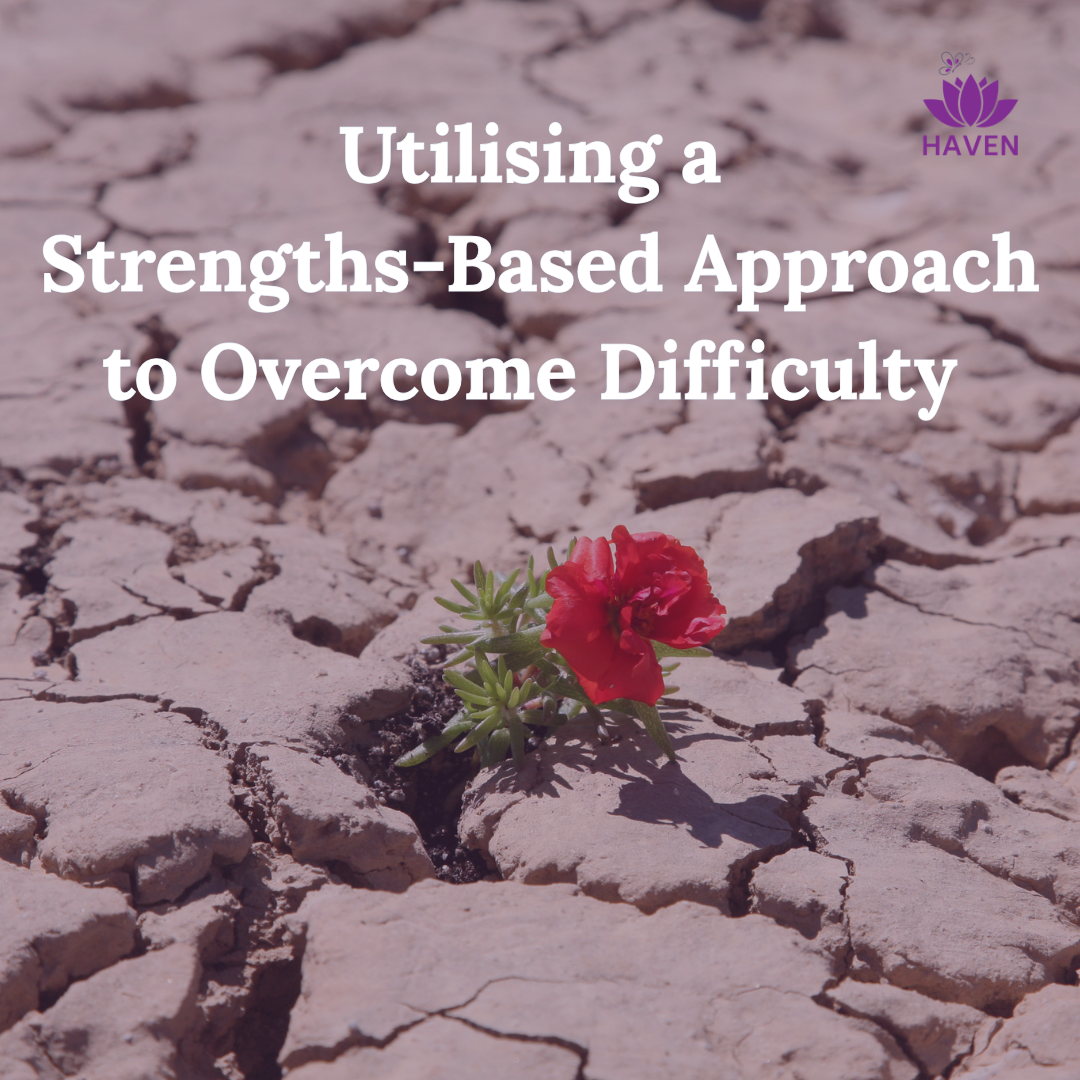
Utilising a Strengths-Based Approach to Overcome Difficulty
This blog has been prepared for you by administrator and psychology graduate, Bridget Joyner.
Have you ever encountered a challenging project at work where you had to rely on ongoing feedback and supervision of a manager? Have you ever used your planning skills to create a running schedule to help you achieve your goal to run your first marathon? Perhaps you are using your ability to write academic research papers to help produce a blog for the first time with the guidance of your colleague who likes blogs a little too much. What these three scenarios have in common is that in each situation you have utilised your pre-existing skills and resources to overcome and grow from a difficult challenge. Welcome to the strengths-based approach. A solution-oriented framework (Anon B, N.D.), originally stemming from positive psychology (Anon A, N.D.), that aims assist you in proactively overcoming adversities.
What is a strengths-based approach?
A strengths-based approach involves identifying and utilising your own personal strengths and resources to overcome adversity. It focuses on your positive attributes, skills and support network around you rather than focusing on your deficits or shortcomings (Anon A, N.D.). This approach assumes that you are motivated to make positive change and are resilient in times of hardship (Anon A, N.D.). Undertaking a strengths-based approach allows you to not only to become empowered and overcome challenges (Anon A, N.D.), but also increase your self-esteem and overall resilience (Marschall, 2026).
Some (non-exclusive) core principles that strengths-based approaches assume are (Anon B, N.D.):
- Everyone has potential (you can do it!)
- Seeing challenges as opportunities (how can you upskill or grow from this?)
- Change is unavoidable (life moves on and so must you)
- Your choice of language dictates your perception (is the rain horrible and cold or nourishing for your freshly planted flowers?)
- You are the author of your own story (live your life the way you desire)
What’s the evidence?
Although strengths-based approach theory still considered fairly new in the world of research and academia, there is already growing evidence in support for short term improved wellbeing across a variety of circumstances. For example:
- Rural communities (Luebbe et al, 2024)
- Adolescents (Fu et al, 2025)
- Serious mental illness (Tse et al, 2016)
- Clinical psychotherapy settings (Flückiger et al, 2023)
- Workplace settings (Breevaart et al 2025)
When might you use a strengths-based approach?
There are plenty of moments when a strengths-based approach may be able to assist you! Try when you are:
- Upskilling/improving at work
- Setting SMART goals for desired achievements
- Identifying suitable career paths or volunteer opportunities
- Achieving personal goals such as sporting or other hobbies
- Coping with a change
What does identifying your strengths actually look like?
Let’s make a list! To come up with some of these strengths and resources, try asking yourself some reflective questions about your own experience.
- What has helped me in the past?
- What existing strengths can I build upon?
- What am I good at?
- What do I like about myself?
- How have I overcome something difficult (or that I initially thought was difficult)?
Not only can you identify your strengths, but you can also identify areas that can become strengths. For example with additional practice, supervision or training you can upskill in an area of interest or practical utility. It might also be helpful to think about what resources you have available to assist you. This could be material like physical resources or equipment, or people in your life, a mentor, an old teacher. There are also other knkowledge sources like the library, community workshops, courses and so on.
Overall, a strengths-based approach holds great utility across a variety of circumstances we encounter within our daily lives. Whether it be minor or significant challenges, it is never too late to make positive change for ourselves. If you are currently seeing a therapist, ask them about strengths-based approaches and how they can apply to your circumstances. Take care and enjoy unlocking your potential!
References
Anonymous A. (N.D.). Strengths-based approaches. https://www.dss.gov.au/system/files/resources/cafis_1h_-_strengths-based_approaches.pdf
Anonymous B. (N.D.). What is Strength-Based Approach? Theory, Tools, Therapy & Examples. High 5 Test. https://high5test.com/strengths-based-approach/
Breevaart, K., van Woerkom, M., Wang, J., & Planken, N. (2025). Strengths-Based Leadership: A Critical Review to Guide Future Research. Journal of Leadership & Organizational Studies, 32(4), 429-448. https://doi.org/10.1177/15480518251342658
Flückiger, C., Munder, T., Del Re, A., & Solomonov, N. (2023). Strength-based methods – a narrative review and comparative multilevel meta-analysis of positive interventions in clinical settings. Psychotherapy Research, 33(7), 856–872. Doi https://doi.org/10.1080/10503307.2023.2181718
Fu, C., Chien W., Zhang, Y. & Lam, K. (2025). Strength-based capacity-building interventions to promote adolescents’ mental health: A systematic review and meta-analysis. Eur Child Adolesc Psychiatry. 34(10):2975-3015. doi: 10.1007/s00787-025-02741-6.
Luebbe, A., Rutherford, Z., Diminic, S., Roovers, H., Patel, M. &Whiteford. H. (2024). Taking a strengths-based approach to mental health in rural communities: A systematic literature review, Australian and New Zealand Journal of Public Health. 48(6), https://doi.org/10.1016/j.anzjph.2024.100201.
Marschall, A. (2026 February 18). How does strengths-based therapy work? Very Well Mind. https://www.verywellmind.com/strengths-based-therapy-definition-and-techniques-5211679
Stoerkel, E. (2019, March 12). What Is a Strength-Based Approach? (Incl. Examples & Tools). Positive Psychology. https://positivepsychology.com/strengths-based-interventions/
Tse, S., Tsoi, E., Hamilton B., O’Hagen, M., Shepherd, G., Slade, M., Whitley, R. & Petrakis, M. (2016). Uses of strength-based interventions for people with serious mental illness: A critical review, International Journal of Social Psychiatry. 62(3):281-291. doi:10.1177/0020764015623970 https://doi.org/10.1177/0020764015623970

